Lunenburg (11140 Miles done)


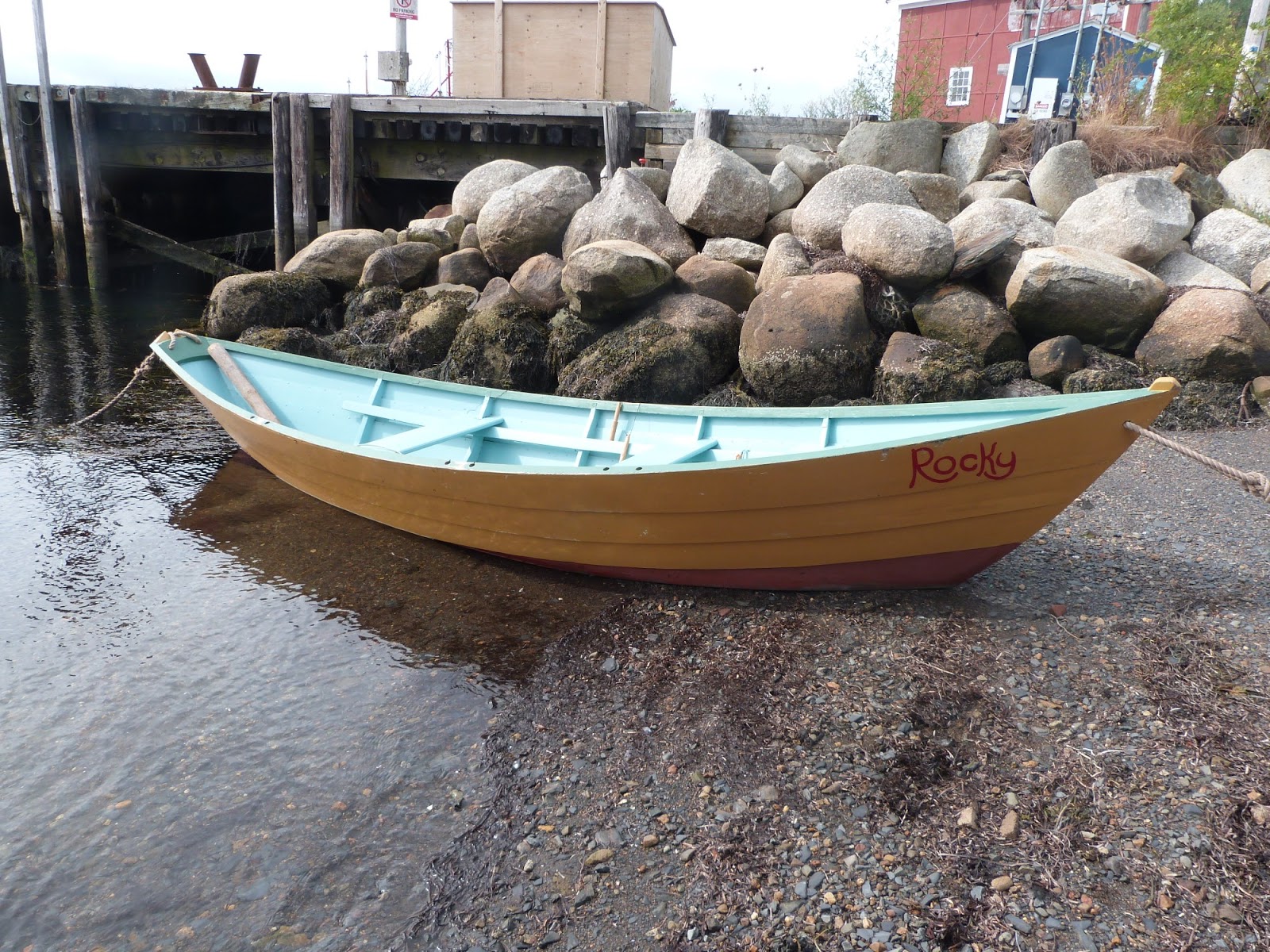
A Lunenburg Dory - built afresh, I get to chat to the builder.

This blog is a bit misleading, the last blog covered Baddeck in the Bras d'Or after which Nick and I head back ( I keep thinking "head South" but actually it is West as Nova Scotia is tilted a fair bit, compass course are also 20 degrees different to true chart courses, so our compass course is actually due West magnetic).

We leave Baddeck, stop again at St Peter to wait for a lock opening, but I blogged about that in the (single) St Peter entry. We sail direct for Halifax, 149 miles and an overnight sail where we pull into Halifax docks, wait a day while some bad weather blows through and visit Lunenburg by bus. We then go to Dartmouth, 4 miles up the river for a cheaper nights stay and to get fuel before departing for Lunenburg again - by boat! however we arrive at night, anchor and leave the next morning early

I hope the photos don't confuse you. I include a few nautical ones, despite being out of order.


On our way back we see an interesting rig, a marriage of a modern Western hull (I think) with a three masted Chinese junk rig? Junk rigs are interesting - all control lines run to the cockpit and it is easy to alter sail area. Not sure about beating ability but Hey, who am I to talk and anyway gentelmen don't go to windward...


We also see .... a black blob which quickly dives away... We think it was a whale as it is quite broad, and big. We also saw porpoises which where camera shy and I also saw a big big turtle a few weeks later in Long Island sound.


And coming back from St Peters we had a sunset - no green flash, but pretty nonetheless.


And then to Lunenburg by bus! I had been told to visit here when I visited the Dory shop museum in Shelburne.


Wall to wall docks, lots of boat activity, once they made dories in 4 or 5 places here
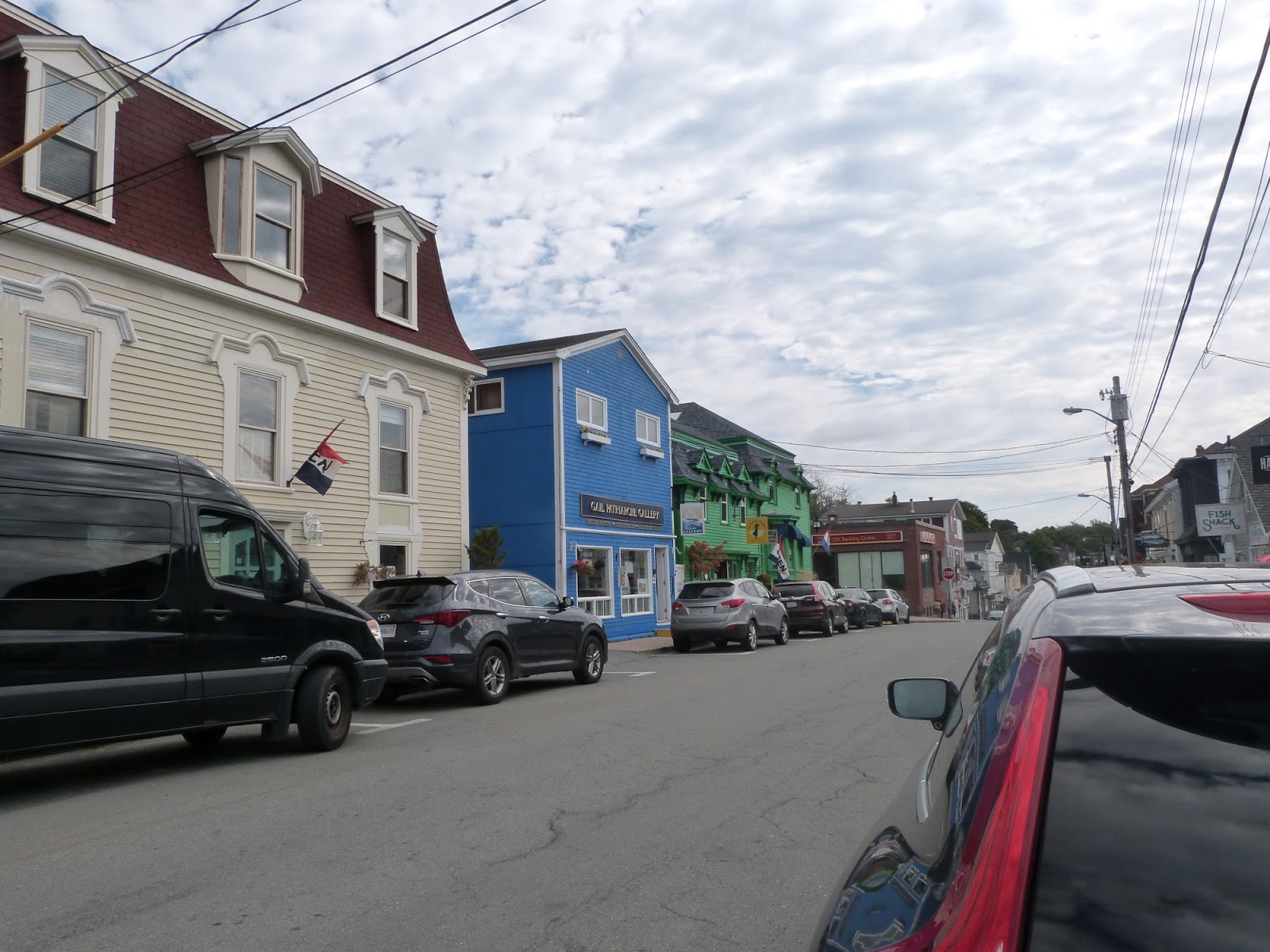
Houses well preserved too - it is a Unesco protected town.


Love the boat, strange place to park


The dory builders also built houses off season - the top dormer window is a Lunenburg trademark


A lot of tourists come here, including us I suppose, there are lots of restaurants and antique shops - and a rather good second hand book shop where I buy 4 books on boatbuilding!


Must have been prosperous as many buildings are large. The boatbuilding spawned lots of support industries to make fittings,ropes, sails and ironmongery - so a hive of industry in its day


And of course fishing as well as boatbuilding, which came first, chicken or egg.


And of course, in these waters fishing was hard, in any waters in fact, boats from here fished far and wide.


Poignant to see how complete families get wiped out when a complete boat goes down. The sea is not sentimental.


Schooners were made here, in this case we test Nick who has been learning Signal Flags - while I revise mine, I seem to have a 90% retention rate. We are so busy working out what these flags say that we fail to notice that the "E" flag is upside down, shame on us... (it says Welcome Aboard)

The dock walk has an Adirondack chair - a better version than some I have seen. This is my first woodwork project when I get home. Nick has trouble remembering the name until I ask him to picture a "deer" on "Deck".

Given the state of my memory I use mnemonic and analogy a lot - to remember the signal flags I have a little saying for most of them.  - The O flag has two ramps (triangles) for instance and I ask Nick to picture someone sliding down the ramp and falling overboard - which is what the "O" flag is used for; Man overboard.


Note the curved back and the curved seat. A top designer would tilt the armrests in a bit and lift the hand resets, if it can be done without undue effort, I am all for the KISS principle to craft work. Shirley and I had visited a chair exhibition in the Copenhagan Design museum a few years ago. Good design should be simple and work.  Hence my fascination with Dories.


I chat to the boatbuilders and they refer to me John Gardiners book and suggest I try the nearby secondhand bookshop which I do. I am also building up snippets of folklore - all frames are the same slope (2 in 1) and are flat of course. The floor rise is about 3 to 4 inches (3.5 in the Shelburne ones)

We discuss American Pine versus European Pine, the Americans have much better woods than us. Pesky English took all the Irish Oak to make ships already... I may have to go to Architectural Salvage companies and "rescue" old pine floorboards when I get home! Iroko might be a candidate for frames though my iroko rudder on my selfsteering is showing splits. I may laminate instead.

The museum in Shelburne is interesting too, though not much on Dories - they do have an exhibit on Bluenose - a very famous Lunenburg Schooner that competed against USA Gloucester boats for a cup - these races were for working fishing boats, none of this highfalutin' yacht races like the America cups, these are real boats, not aircraft that pretend to go on water and cant sail in more than 27 knots of wind << rant mode off >>


The competition...


We also had a lecture on the history of the bluenose and her captain.

All to soon, we return to the bus, not as well organised, or as cheap as the Bras d'Or ones but certainly handy - it drives through Mahone Bay on the way back - Stephen, the commodore of Dartmouth Yacht Club had told us that he has spent years cruising the bay and it has beautiful sailing, the town we pass through certainly looks lovely. (I hope I haven't mixed up houses from Lunenburg with Mahone Bay - but they are all in the same county)


And finally, halloween is coming? or maybe they just eat a lot of pumpkin pie. Castleward's pumkinfest would go down well here!

And then we continue back to Halifax, then back to here for an overnight anchor before heading to Shelburne where we wait two nights before heading to Boston - 290 miles which we cover in 48 hours. This includes 5 hours of force 8 and 5 hours of force 7. Nick saw 10 knots on a beam reach  - with two reefs in the main and a small number 2!  Gribs had said 25 knots, they lied, gribs often underread by a beaufort force (see www.passageweather.com )

Suprisingly cold in Nova Scotia but weather in Boston runs hot and cold, depending what day it is. We seem to be getting one bad day and two or three good days as fronts "Northers" come down from the lakes. I will be weather watching closely from now on.


Bras D'Or Lakes; Iona and Baddeck (10,906 miles)


Having waited at the lockgates (and visited St Peters and the Distillery at Glenville) we enter the lakes - very large body of water, pretty much landlocked, there is a narrow entrance at the top and the lockgates at the bottom (St Peters). Scenery (and weather) lovely. A very special place. Sailing here is great, flat seas, bright sunshine and normally 5-10 knots of wind. (we usually had less...)
 On the way through the lakes there were a few houses, and also an first nation reservation.


St Peters to Iona was a pleasant 20 miles, there is a bridge here that needs opened, this happened promptly when I radioed the bridgekeeper. On the "other side" there is a government wharf. We came across a lot of these, built for fishermen and recreation I tend to keep clear if they are packed with fishing boats (fishing boats sometimes play dodgems). I need not have worried...

The roller reefing had jammed so we dropped the sail - I later discovered if the halyard is too tight the foil lifts up and jams the top swivel  - I will go up the mast before crossing the Atlantic to check this. For now I keep the halyard loose.

Although fender boards were called for there was also large tires helping keeping us off. A couple of rod fishermen helped us dock. There was a wild current approaching the pier, but we crept up to avoid it here.

Lonesome ownsome.

There is a lovely church here but the main draw is a Scottish Gaelic museum. A stiff 30 minute walk away.


 Saw some nice houses on the way


They go in for big lawns here - maybe they like ride-on mowers, maybe to get a breeze and keep the insects at bay?


And then into the museum - think Ulster Folk and transport, without much transport...


There is an authentic ole fellaw with a hat! This house and the next is a bit before and after - the above is a copy of an actual Scottish house (bothy?)


A lovely touch is that the place is full of character actors - she told a lovely story and answered questions as if she was about to leave her native home, Out in the outer Hebrides. (Barra)


They could only travel with what they could carry, Men brought there tools, often without shafts to save space. The women dressed up in 4 sets of clothes to bring more with them. - sounds like how to defeat the high hold baggage charges of air travel today?

First generation arrivals got a log cabin build quickly


Needs a lot of axe work, but fairly warm I would think.


Complete with stone fireplaces and civilised living (relatively). The (new) islanders prospered quickly and the next type of house and contents were even better


And they worked hard, sheep were plentiful then (but none or few now - I suppose there are massive sheep farms elsewhere in Canada which don;t require as much land clearance and are now more economic. Money, money...) Not sure what the locals do now, maybe work in the museum?

Again the actors did a good job - all speaking Scottish Gaelic, a bit different to Irish.


Farming was big then, here is a collection of carriages and assorted tools


A dead popular carriage!


Winters are not too harsh but sometimes you need sleds. On a good year it only just gets below freezing, In a bad year maybe -10C


And of course tools for woodwork and blacksmithing were essential


A lathe for making round things (usually)


These tools are still used today, not many electric routers, planers or sanders about... no cordless drills either. Gulp.


I did a night class in welding and foundry work in Bangor "Tech" a few years ago, this chap is quite good...

Houses improved again - due to prosperity and now had sophisticated stoves and more intricate furniture.


The earlier spinning wheels now augmented/replaced with more sophisticated machines.

Of course I also studied the timeline of chairs I saw.


Some boats (and some people) have a large beam.


The twiddly sugar cane bits need a lathe...

I still favour the Adirondack designs

There was also a local store with a lovely wee storekeeper to talk to .


You could send letters from here too.

There was also a school and a few other buildings, including a church that had been floated here and set into the museum.


I forgot to photograph the church - but you can see it here.


And then to the boat - Iona was a daytime stop for 3 or 4 hours, we had 10 miles to do to get to Baddeck.


Another nice house on the way back


Nick is sitting in the designated smoking area - the poop deck as others know it. He is giving up soon.


And into Baddeck, one of the bigger towns. We visit the Bras d'Or yacht club - a lovely place with a singer, audiences of 5 going to 10 later on. The barman is chatty and gives us some beer tin coolers! The town is behind a small island which gives good shelter and we anchor just off the club. Marquee tent is up and we wonder if they have a sailing event about to start - turns out to be a wedding, we are away the next day before it gets going.


Lots of moored boats

The town is a pleasant wee place


Who knew. Alexander Graham Bell was a great technical fiddler and turned his hand to many things. He wisely left his wife in charge of the money and concentrated on playing with his toys. Though he did have a considerable social conscience. He was involved with the Aerial Experimental Association.


Now, this is really good, if you pay money eventually these actors might move!


A boardwalk around the shore.

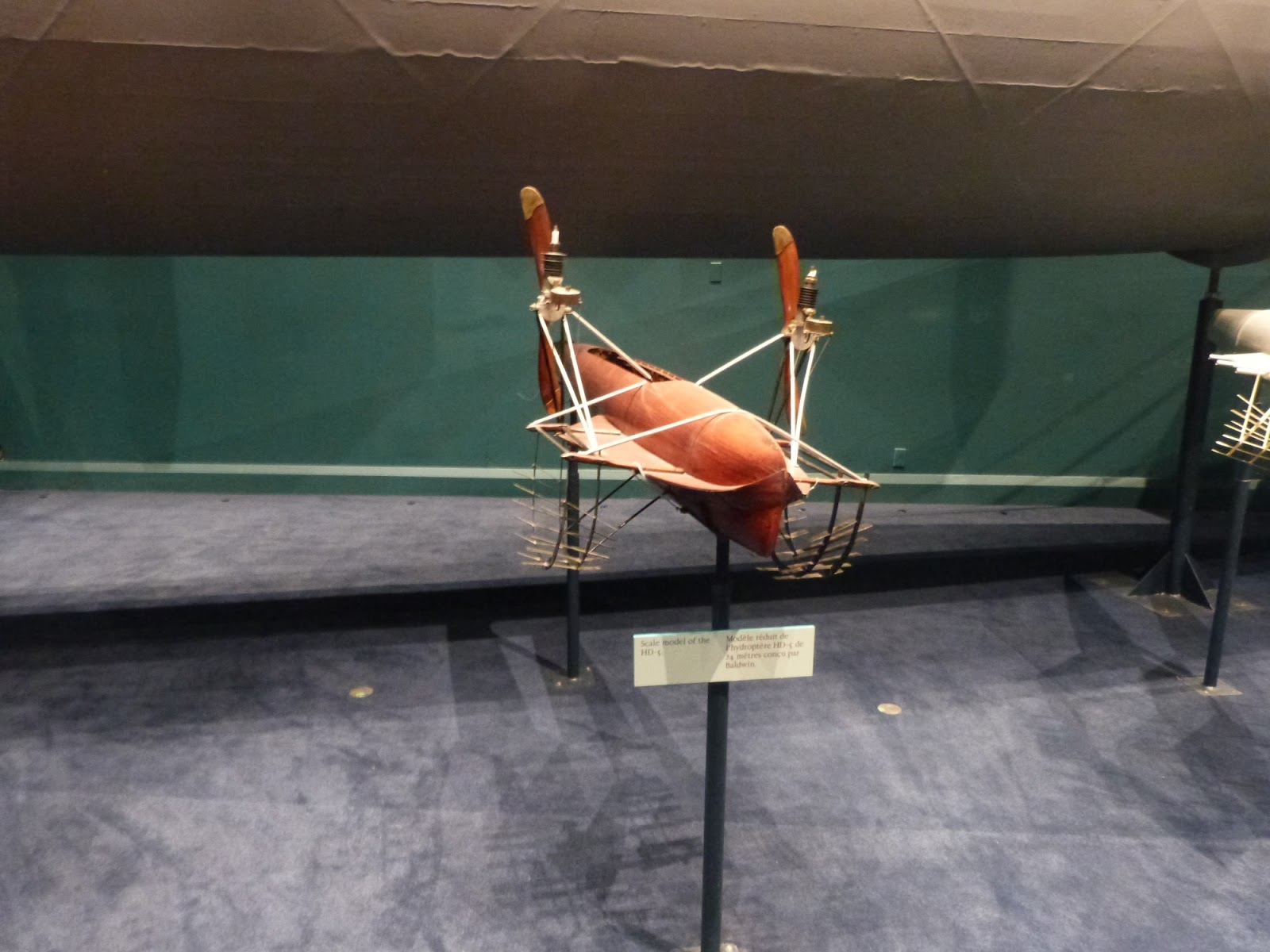
The main draw to go to Baddeck for me was to see the Alexander Bell Museum. As well as telephones he was involved in a lot more. As was his wife whose philanthropy and involvement in the town was rewarded by her getting the vote before a lot of other people - not bad for an American. Alexander was heavily involved with flight - both very early planes - after he saw (or heard of?) the Wright Brother's efforts. He also designed and  used Kites to carry observers aloft. He had a big collaboration to build the first hydrofoils. He even started/co-founded the National Geographical Society and invented the term greenhouse effect.


His dad and he worked a lot with deaf people and worked out how to speak - invented ways of describing sounds in terms of where your tongue, palette and lips must be and how much air used etc., very scientific, I found this interesting - my colleague Frank Owens from work has done considerable research on a really neat speech model involving calculating the airflow through 34 pipe sections (with a Y-fork for the nasal bit). His work generates very (very) natural sounding speech.


A man after my own heart, I know if he was alive today he would use ducktape and araldite, a kindred spirit.


Not a UFO, this is a hydrofoil, the "boat" climbs out of the water as speed increases.


We saw a poster of this in Halifax too. Must have been some machine.


Bell also found time to go sailing


He also used light as a way of sending messages, not quite optical fibres but impressive nonetheless


And of course there were lots of telephones


When they say that Bell  built the first telephone, this is not impressive. What is impressive is that he built the first two telephones.

He also loved kites - and the terahedron shape (did you know that the terahedron is one of the five platonic shapes?) A tetrahedron is comprised of 4 equilateral triangles - a mystical shape you can draw a cube around it. The four points are equally distributed around the cube, across face diagonals


He had fun.

And then I and Nick turn around and start to retrace our steps. I realise that I am at the turning point of my adventure. I am on my way home. Slowly.

Diving in the Bahamas with Colin and Eileen mid November to Mid December.

Christmas in the Virgin Islands with Shirley,

January in the Caribbean with Ian and Francis,

Lower Caribbean and the ABC islands with Eamon and Kieran  Mid February to early March.

Up to Puerto Rico with Alan,

Puerto Rico with Gwen and Shirley, beginning of April

then Jens and Nick and I head for the Azores, via Bermuda. A planned May 1-3 departure.

D.V.