Northern Florida 2 St Augustine (mile 8602)


I know what I'll have to make when I get home... We visit St Augustine - an important historic town. There are a lot of well preserved buildings and the local college (university) is in a really well preserved set of buildings built I believe by Henry Flagler - he was a partner with Rockefeller's venture into oil and owned the railroad that supplied the town- he must have been worth a bob or two! He built the Alcazar hotel which was a the height of luxury, in 1888. It was bought by Otto Lightner a publisher from Chicago in 1947, he was an avid collector of lots of things, he bought the hotel to store his "stuff" in. In due course it becomes a museum which John and I visit serendipitously. Here are some shots from it.
At the entrance is a reminder of our mortality and the role of fate in our lives.


Ah well, it will be what it will be then... Ironically (which perhaps the Americans don't get) the Museum also offers space in an adjacent wing to a number of government and city offices, including the register of berths and marriages and where you register deaths. I wonder... maybe there is someone with a sense of irony.
In the meantime we continue our browsing.
The first exhibit is a massive grandfather clock - british. John has made clocks as a hobby, cutting the cogwheels using a homebuilt CNC machine, He is now interested in Kinetic art which gets a boost in St Augustine as well.

Two grandfathers


I am, interested in the clocks ability to show the phases of the moon - far harder than you might imagine - I had once worked out the rato of teeth in the cogwheels in an ordinary clock and as an ocean navigator have studied moon tables. It is very hard to get accurate moon phases, it could double the compexity of the clock if done accurately. (and would still lose "time" a wee bit.) It takes 19 years for the moon to get roughly back to the same position in the sky - the moon wobbles up and down, speeds up and slows down and moves further away and closer to the earth in beautiful complex paths... << geek mode off >>


The moon phase is in the top pf the glass window.
The other clock that impresses me, also British, is in the Hermitage in St Petersburg, it has a mechanical peacock that struts its stuff on the hour.
There are other mechanical gadgets that obviously took Flagers fancy too.

Note the scale by the size of the normal/small drafting tools in the background.


Building engines is also what old retired engineers should do - I am interested in Stirling engines that convert any source of heat into motion, they deserve to be rediscovered and used with solar collectors (and concentrators)

There is also a collection of word processors ... ( typewriters, or stenographer machinery.)


We spent little time viewing the vases, the jewelry, even the paintings but here are a few other things that grabbed my eye.


Funny American bank notes, that became worthless, banks always seem to have a heads they win, tails you lose approach to money. 

I wonder how many Americans are born with silver spoons in their mouths.


He had a thing about shells too - some of these are massive
I set my watch beside these, I can recall a black and white film where a deep sea diver gets his foot trapped in one of these. 

The other thing in the museum that tickles me is a collection of chairs - I once photographed (and sat in) 150 chairs in a special exhibition in the Design museum in Copenhagen when yachting there in a previous cruise. Thanks Shirley for your patience!
Here is one for fat people (ahmm, no comment)


Hand carved wood.  These last two shots remind me of a visit I had in Romania, to the Summer Palace. The chair and table there were Indian and had taken three generations to make. Gob smacking when you think of it.


Well, they have to use up the horns somehow. Wouldn't be in good taste now I suspect


This isn't actually in the exhibition - it is just a modern chair for the staff to sit in. It is see through, but I don't see it myself.

Finally there is a collection of music making machines - a large collection actually, and we are told that there is a demonstration and talk at 11 o'clock which we attend.
There are machines that take punched cards, or cyclinders with pins sticking out or copper discs with holes in them. One machine has a violin and a piana, there is also a "Monkey grinder machine"


I am old enough to have used punched cards to program computers - one card for each line of a FORTRAN or PLAN program, I then moved onto paper tape - also full of holes...Nostalgia ain't what it used to be...


 We miss "fika" ("Elevensuses" in Belfast speak) but manage to use the museum cafe, no pastries but I rough it with chocolate fudge cake and cream.


After coffee we continue our tour of the town


John is wearing a T-Shirt promoting his son's most excellent company and he has been tasked to get photos of it in lots of places.
We also wonder if Peter Kirby Smith - one of my Atlantic crossing and Caribbean crew has been here before us.


The one on the right is a "Kirby Smth"
The buildings are lovely


The smaller buildings are now designed to make money out of tourists, eat, drink or buy. If you can't beat them join them, we have a Guinness and a Harp (and food) at the Irish pub that evening.


In one of the tourist shops, John spots a kindred spirit selling beard grooming instruments and it may be a foothold for his son Adam to get a distributor for his Belfast Beard oils and Combs.


We also visit an art gallery that is displaying backlit - almost flourescent "paintings" (some are doctored photos) not our cup of tea, but they also have exhibits with moving parts - gladdens the heart of any engineer.


The cogwheels turn (but don't do anything)

I suggest John goes home and makes some clock like kinetic art arrangements with edge lighting and flourescent marker pens on acrylic wheels and sends one to the Gallery on sale or return - let the gallery set the price and give John half the money, I wouldn't want more than 10% for the idea... As the gallery sells some of its works at high 5 figure sums this might be a good wee earner!
Finally, every town has a castle or fort and St Augustine is no exception, we baulk at paying to get in and are too tired to storm the battlements and it doesn't look very impressive (John lives near Carrickfegrus and I live near Winterfell...)


They have a nice selection of cannon (some of the might be morters or named something else) They look so good I thought they had been hammer-rited or maybe "Repro" rather then Renovated but I am wrong, they are orginal.
We depart St Augustine well rested and sail outside for the run up the coast towards Brunswick. Getting out the entrance is made interesting by three dredgers and tugs, and associated floating pipes going everywhere, but by calling them on the radio they direct us to a safe route past them, We anchor twice on the way to Brunswick, at Little  Tiger Island and just off Jeckyl Island where we go ashore and have an interesting time. Jeckyl Island is my 100th stop since departing Belfast. See the next blog

Northern Florida 1 - Miami and the ICW (miles to date 8437)

John Henshaw and I depart Key Largo for Miami  - I have DVDs on board of CSI Miami and we watch these instead of reading proper guides…

Entrance by Sea is fairly amazing – a big long ship channel with skyscrapers each side. The entrance is called the Government Cut and is blocked to pleasure craft if there are Cruise liners in port. Luckily they had all left when we arrived (they leave at 6pm in most places). When we leave Miami we are diverted from Government cut to a nearby side channel South of the cut but this only adds an extra half mile to the journey.
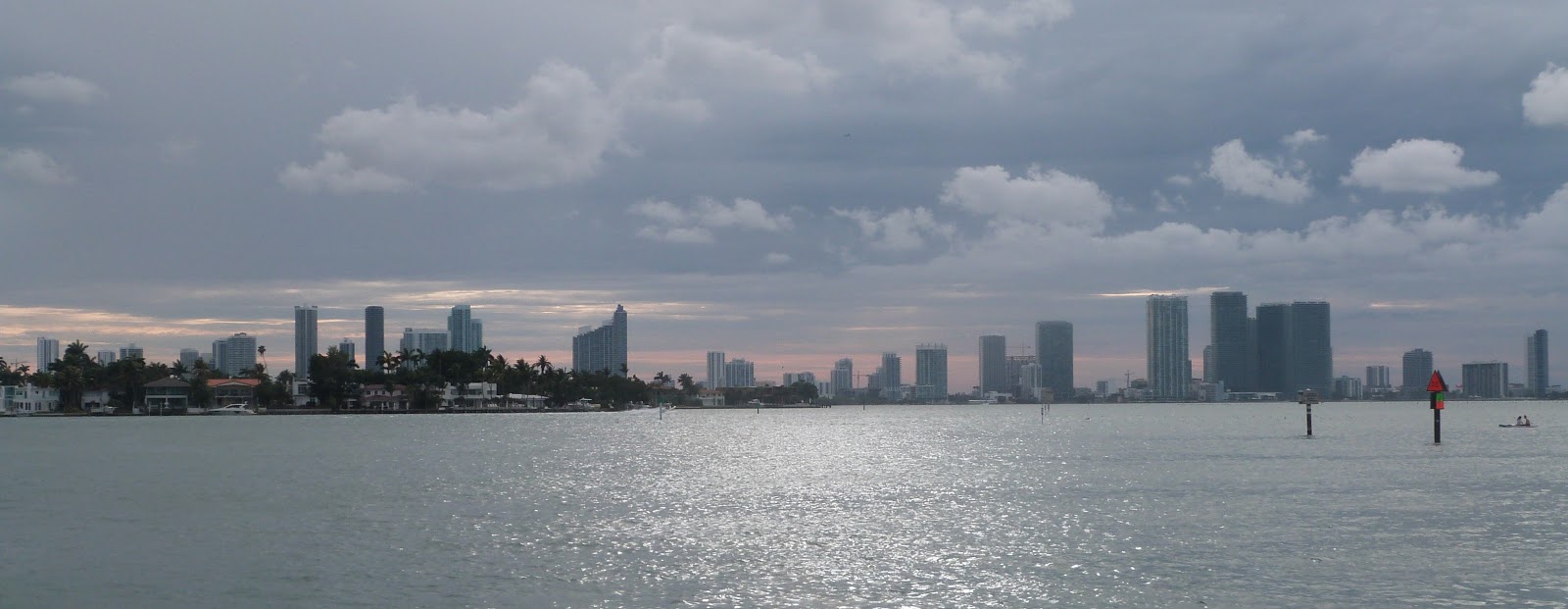
Miami, or more correctly Miami Beach is fairly amazing – to anchor a yacht in the heart of a city. In fact there is water everywhere – there are channels and artificial islands with buildings on them, docks are everywhere – a theme we find in Florida.


We took the yellow track on the way in. Each of the rounded rectangles have houses, each with their own docks. Usually powerboats – dictated by the very shallow waters. We had to creep in slowly with Shadowmere as she has over a six foot draft. 
Some shots of our anchorage 


There are a lot of paddle boarders. Kayaks and a couple “walking across the water on these…
Maybe these will catch on in Belfast… better than going up the Lagan in a bubble.

The next day we go shopping – by dinghy, there is are small canals running through the city

On Sunday we walk across to the Miami Beach, the beachfront is a boardwalk, backed by large number of exclusive hotels – they have pools and seating areas but you need keycodes to access them. Being early on Sunday it is all a bit subdued.


A lovely old church (Synagogue)

The Miami Convention centre is a massive building, maybe the facades had Irma damage


I should explain what the ICW is and how it will feature in our travels; The IntraCoastal Waterway is a web of channels and rivers that allow passage from Norfolk Virginia to Miami and beyond. The Miami to Norfolk route is 1088 Statute (land) Miles to Key West it is 1243 miles. There is also a versoion of the ICW that runs West along the gulf coast but it has lower bridges and does not suit sailboats. In fact depths from Miami tp Key West don’t suit big sailboats either but From Miami to Norfolk the bridges have an airdraft of 65 feet or open on request (there are 88 bridges in total) The depth of water varies but is meant to be 10 or 12 feet. Georgia only manages that when the tide is in however. Florida spends a lot of money on upkeep, Georgia relies on Federal funds. (Florida levies a tax on all waterside properties – and there are a lot of these!
When I said there is a 65 foot lower limit from Miami to Norfolk, there is one exception. The Julie Tuttle bridge has a clearance of 55 feet. Shadowmere needs 59 feet. Hence we go “outside” on our first part of the ICW – In fact we go outside a few times to allow sailing as most of the ICW has to be motored.
I am looking forward to doing the ICW, the scenery and small towns offer an insight into America you could not get any other way.
Anyway, bridges!

The ICW is also well marked with red  and green numbered triangles and special pilot books to guide you – and give the name and procedure for each bridge  - some are timed openings and some are on request with rush hour traffic having priority. I have small scale paper charts from Key West to Canada and three types of electronic charts – the Garmin Chartplotter, Navionic charts on my UK phone and the American NOAA charts on my US phone and laptop. There is also an excellent app(and website) called Active Captain that has crowd sourced data on marinas and anchorages on the ICW and surrounding areas, as well as reports of shoaling, missing marks and user reviews. Most excellent resource! Dave and Mary from Wandering Rose that we met in Havana have also given me a paper book  ;Skipper  Bob’s”Anchorages along the ICW”. Even so without small scale charts I have to do my homework and look ahead to plan what to watch out for.
Because of the Julie Tuttle bridge, John and I exit Miami back onto the open sea and have a pleasant sail to Fort Lauderdale – and from there onwards to Palm Beach (Lake Worth) and then onto Fort Pierce before going “inside” and up the ICW. This is a good strategy as we miss a very high density of opening bridges. We also go outside from St Augustine to almost Brunswick – just to have a sail.
We arrive in Fort Lauderdale as it starts to rain, and rain, and rain. Joined up thunderstorms for two days. We manage to anchor in a small lagoon called Lake Sylvie, it is surrounded by private housing each with their own private dock and no public access whatsoever. However the rain keeps us below anyway. And two days later we leave and head back out to sea.

To give you an insight into how rich people get their houses built here look at the chart below, the dreged channles are to ensure everyone gets their own dock. (Key Largo was like this too)


Our route in and out is in yellow again
Here are some google Earth screendumps too.


Big boats!
We leave Lauderdale and go 57 miles up the coast to Palm Beach also known as Lake Worth – 

We pass a towboat towing a small boat - the TOWBOATUS company offers a service like the AA. I heard a superyacht call one up to help it into their berth - they had "gold" coverage. Normal fees are about 250 USD a year and since a tow without membership would cost 4 figure sums it might be worth it  - if you only have one method of propulsion. I am a bit put out when I hear a yacht call for a tow when their engine stops - and they are out in the open sea with no wind "the sails are just slopping about". Why don't they wait for wind, or anchor!


Anyway, our outside passage has enough wind for us. (the yacht was 20 miles south of us, 3 miles offshore)

Google Earth shows the inside route is just past houses again


The entrance from seaward is along a dredged channel  - with lots of shallowish water to eirther side. Deep enough for the boat but in a bad gale or with a big current coming out and meeting an onshore wind the seas would be big. This is a recurring feature right along this coast - some of thge "big ship" inlets are without doubt survivable in a sailboat that can do 5 or 6 knots but it wouldn't be comfortable. Some of the other inlets are not very survivable in the wrong conditions. Also you waste a lot of miles getting in and out of these inlets.


We meet much opulent housing and boating until we get to Fort Pierce which is just a normal town - pleasent marina, nice (cheap) cafes and some normal buildings. I find a ACE hardware store and buy an aersol of yellow paint and a few nuts and bolts. Why do I need yellow paint? I had stopped to buy fuel in Fort Laugherdale and they refused to fill my red diesel cans - the US coast guard (USCG) have a regulation that states diesel goes in yellow cans, and gasoline (Petrol) goes in red cans. This is to make firefighters lives a bit safer I suppose. 
Now, in Europe I guess 90% of us use red cans, I even have a red can that has DIESEL embossed in it. I am furious as I bought extra red cans in spain and in Key West - cleverly using hardware stores at one third of the cans in the marine stores. The aerosol says it paints plastic and dries in ten minutes. I will need a calm day and a wide open space protected with a big tarp before I can paint however.  Here is my entrance into Fort Pierce


We actually stay here two days, once in position X and then in the morning we explore by dinghy and decide to move the boat to "Y" so we can use the dinghy dock in the municipal marina South of the bridge. This is free although showers are $5. We need showers.

Fort Pierce has small boats at anchor - one is a canadian boat from just south of Nova Scotia. We have a brief shouted conversation as we pass and he gives me his facebook page and says to give him a call when I am up that way. The waterway here has a bit more nature than previously - 


After leaving Fort Pierce we go inside - some quiet canals and waterways


We even come across some public docks - mainly used by fishermen. Later in Georgia and South Carolina most towns have free docks that can take sailboats - with timelimited access and rarely overnight stays are permitted. Actually this is not too much a problem as you can basically stop anywhere and find ten feet to anchor - as long as you not in any one's way. The waterways are actually massive - the ICW is a minor part. I had though that the ICW would be this straight line running South to North, In fact it meanders West and East,rarely going Stright north - it crosses massive numbers of rivers and esturaries - they US military engineers have created "cuts" that go from one river to another and this allows progress to be made Northwards and Southwards. A few cuts have shoaled up, particularly in Georgia where they only use federal funding. But at least Georgia has 6 - 8 feet of tide so 3 or 4 times I have to wait for high water to make the traverse across the cuts more stress free. I also set the alarm on the echo sounder and a couple of times a day have to swing one way and then the other to try and find the deeper water. It is a skill that takes some time to learn. And of course you take every bend wide  - the deeper water is the middle of the channel. The river breaks out into lakes sometimes and we also see a dozen wrecked boats, either from neglect (likely) or Irma (the hurricane) I know not which.


We see vast numbers of signs about Manatees but only catch one momentary sight of a Manatee - or a big grey lump that moved. We do see Dolphins nearly every day but they are a bit slow and languid. No jumping out of the water to pose for photographs!


Shadowmere just does slow and has no wake either...


And then we move on. After Fort pierce and going up the "inside" we pass Daytona beach but don't go ashore (it is raining again) but have a pleasent (free) anchor in a lagoon behind the beach. The channel passes Cape Canaveral and had we had less draft we could have diverted into a separate canal and got much closer to the spaceport. The ICW takes into Mosquito Lagoon although a useful side effect of the rain is that the mosquitos can't fly! The lagoon is very shallow but we nudge our way off the ICW and find 9 feet of water to anchor in. Next day we find the parts of the lagoon are campsites and seem to have trailerparks with public launching ramps for fisher men. At least this part of Florida is not full of millionaires.
We head to St Augustine next and spend a day or two there being a tourist. And then onwards to Georgia and beyond!