Sint Maarten St Martin Potato Potaatoe (Aardappel/Pomme de Terre)

We leave St Kitts at 22:00 at night and arrive at St Martin just after first light - we had 30 knots at times and more uncomfortable rolling in a fair size swell. When we arrive the weather starts to improve and finally the last three weeks of stronger winds are over for a while - a week or two we think. The Sea is a lovely colour, we anchor off and the Captain goes in to clear customs, immigration, port dues etc. Only takes an hour.

A note about the name; St martin is an island split by a "border" the south bit is Dutch and called Sint Maarten, the North bit is French and called St Martin. However there is no sign of any dutch influence here - feels very american actually, with a main "strip" full of cars and a plethora of restaurants, cafes, pubs, and casinos. Locals are only allowed in the Casinos 4 times a month although this is unenforceable of course.

The anchorage in Simpson's bay is only used by a few yachts - most go through the lifting bridge to a large inland sea, there is a further bridge in the North for french yachts to come into the lagoon, and there is a bridge bisecting the lagoon too - with a lifting part too. There are fees to lift the bridge and it only opens a few times a day, we elect to stay outside, the dinghy and outboard are working well - Doros the Outboard "Whisperer" talks sweet nothings in the outboard's ear every day.

The customs dock is to Port before the bridge and Simpsons bay yacht club is to to starboard after passing under the bridge in the punt, it has a dinghy dock and cheap beer, coffee and free Wifi - what's not to like. Nice staff, one from Armagh.

The bridge can pass superyachts, tight enough!
Our immediate impression of St Maartin is many signs of devastation, lots of the cafes have either tarpaulin roofs or no roof and are operating out of temporary shacks. less than 25% seem open for business. On closer inspection many of the bigger buildings are non-functional, they may look ok at a cursory glance and then you realise there is no roof, or that all windows are missing. A missing roof means the interior has been trashed by water. A local taxi driver tells us building materials like sheets of plywood have tripled in price, and you need to wait unknown lengths of time for delivery. Tradesmen are not available, no-one has any money to rebuild, only some are properly insured, government state aid is slow or non-existent. We learn that in the BVI that large contractors do not trust the government to pay and the UK had to act as guarantor for a contract to replace power wiring. Fraught with problems as one politician insists his house gets wired up first, and then another politician and another- the wiring is done in an uneconomic order rather than systematically. This is a BVI story but this type of problem may well be endemic in the Caribbean.


 This church in the poorer part of Philippsburg is open for business from an adjacent  marquee
 This roof belonged to a building 100 yards away, we talked to a man whose mast was carried away by a catamaran flying through the air - his boat hull was untouched. One report says winds were sustained at 180 mph with gusts to 220. Another says winds hit 280mph which is gob smacking.
At least they are rebuilding the churches. I hope prayer keeps them safe this summer.


I had thought after a singular event like a hurricane disaster it would be all hands to the pumps and it would get sorted, people rise to occasions, flourish in adversity... the reality is that it must be like wading waist deep through a quagmire to get things done, profoundly depressing and it must knock the stuffing out of people - it would be ok if it was just the odd building or so, once the number of buildings hits a critical mass there is too much competition to get things sorted. I do see some building work going on, and people seem cheerful, or at least realistically resigned to their fate.

Then there are the boats. The charter industry here lost 80% of its fleet, it has ordered new boats to the extent that the boat factories in France have the next two years of production spoken for  - a private individual wanting a new boat from some factories will be on a two year waiting list.

Worse is the private yachts, whether insurance is a problem, maybe the age of the owners mean they don't have the energy to cope or the loss/damage is too heartrending to do anything other than walk away I don't know. What is clear is that there are many wrecked boats sitting untouched 6 months after Hurricane Irma.
We see similar (worse?) devastation in the British Virgin Islands, the charter companies are doing ok but private yachtspeople not so much. Hurricane insurance for yachts in the Caribbean is interesting, I am insured with Pantaenius - one of the high quality insurers; they allow various scenarios to offer cover in this area - you must lift the boat out, dig a trench, line it with tires, sink the boat, remove the masts and they will cover you  - but they raise the excess to 20k, You are also allowed to dock in a hurricane hole (mangrove swamps), This didn't work in St Martin this time, the mangroves disappeared.


It is not all bad news though, we find a working sports bar to see Irelnad win at the rugby - Doros has the t-shirt (and the beer) to prove it.
We go across to the nearby town of Phillipsburg where cruise ships call - not that frequently now.
Nice beachfront with associated cafes, usual "cruise" shops
We also go to the beach at the end of the airport runway - famous for thrill seeking eejits

You guessed it, lots of people put themselves in harms way for the "thrill"
 We have enough wit to watch from the nearby cafe (it being beer o'clock when we arrive)
This is a small one - the KLM jets come in lower!
 We also visit the french quarter (half!) and find that there is some devastation but more seems to have been fixed, the nearby fort offers good views of Marigot bay - the french capital
 The french bit seems much more chic, even if some of the roofs are still "tarped" The shot above also shows the inland lagoon. - the two halves of it are visible, Also nice view of St Kitts - the shadowy tall island in the very far background.
 There is a good marina here, although this is on the North coast with prevailing winds it does seem sheltered.
After this brief visit to St Martin we have a beer and go, the wrecked boats where one thing,  the broken buildings that had not yet been fixed where another that made us want to leave, I may revisit in a years time as there are lots of chanderly and repair shops for boats, although prices are very high.

With light winds we leave at noon and arrive in Virgin Gorda at first light, a quiet pleasent sail with (finally) full main and number 1 genoa. I remove the bimini so we can steer by starlight and moonlight - magical sailing, finally!

Videos from St Kitts Dive

Fish galore, bit like diving in a tropical fish tank
Lionfish are a major problem in the Caribbean and it is getting much worse. An invasive species that has no natural predators, The female produces eggs every 4 days! we need to kill them.

Finally a turtle, I shot this for Alan who was keen to see one.

Nevis and St Kitts


We meet Tommy the Turtle on a dive on St Kitts.

Nevis and St Kitts are only a few miles apart and are federated together, we arrive at Nevis first, it is the smaller island but we stay here for 3 or 4 days.
Charlestown is fairly small, we walk around it in half an hour, Ferry terminal welcomes cruise ships but there is not many "Funny Disney like shops" that we had observer in other Cruise islands - we see a good example of this in St Kitts later.  Actually only small ships call at Nevis and they do not dock but have to anchor off. 
Alexander Hamilton was instrumental in drafting the constitution but arguably more importantly he founded the concept of capitalism, borrowing and spending other peoples money, I wonder where we would be without him... he does get his face on the ten dollar american bill.

We visit the museum, along with cruise ship passengers. 
And we also wander around the town, not touristy, just a small working town. There are celebrities here - John Cleese was in the supermarket a few days ago. There are converted sugar plantations in the hills, the beaches are good, we are anchored off Penney's beach a mile North of the town and go ashore on Sunday to a collection of (many) beach bars, Sunday night is when the locals let their hair down and the loud "music" is .... remarkable.
We meet Ruth and a couple of her friends for a drink, we end up going away from the noise, inland to a nice Indian restaurant for something to eat after getting a lift.

The town itself has some nice houses, and a lot of banks (as does St Kitts)


Churches do feature here, but not the vast number of different versions of faith worship we have seen on some islands  - 14 different denominations on Antigua - sometimes 4 churches adjacent to each other, All the same God I guess, such is human foible (or vanity?) Nevis and St Kitts have retained a fair amount of British influence.

There is also a big school and associated sports ground. Cricket anyone? The schools throughout the Caribbean have kids in really smart, well turned out uniforms. Looks good, no rebellious examples of the "modified uniforms" some kids use in Ulster.

Here is the first Hotel, not sure if on the island or perhaps in the Caribbean. I had met a lovely man who had come back to the Island to retire after working in Manchester. He had renovated the outdoor hot water baths pictured below and the hotel above is (was - it's shut) was known as the Bath Hotel.
Given the state of my crew I tell the man I would hope to persuade them to come up and bath here. No soap allowed. I try and make a donation for its upkeep but he says no.  He is happy to work away in his retirement.

We also visit some "posh" bits - this is the Golden Rock Restaurant (boutique hotel I think as well). A converted sugar plantation, it serves the best lunch in the Island, thanks Ruth for the recomendation.


We take a taxi around the Island, it doesn't take long to circumnavigate and call at a beach in the North where there is a dive school at Ouilie bay. The ownere Ellis is a bit laid back and vague about the pricing. We resolve to sail up and anchor in the bay and make tentative plans to dive - he has a wreck dive over on St Kitts.
 A few miles up the coast
Still windy but we manage to anchor in very shallow water. On going ashore Ellis is nowhere to be seen, his staff quote a price of 120 USD dollars for a single dive and we decline. After a good coffee we reluctantly leave Nevis (there was to be a friday night barbecue and singsong on the beach)
And off to St Kitt's 2 miles away and 5 up the coast to the town of Basse Terre and the port area of Port Zante.

Two cruise ships nuzzling. This is cruise ship central - five squeezing in at a time. Port Zante has been built on reclaimed (landfill) land in front of the real town. It is comprised entirely of shops selling handbags, jewellery and watches, T-shirts and hats, knickknacks (knockknicks?) and tourist stuff. With over 4000 tourists coming off the bigger ships I guess they do good business. The island suffered a little bit from the recent Hurricanes but nothing like what we see later in St Martins

 Above - the modern shops, below the real town

We eat in one of the restaurants after the passengers have embarked for their tea on board - best Indian meal I have ever eaten, They also have good deals on buckets of beer, 6 for 20 USD.

We also take a taxi tour around the Island and visit a Batik shop where we get a demonstration of the wax painting and dying techniques that make the fabrics really vibrant.


Now, Shirley likes cushions, me not so much, but I relent and buy her a present! She will see it in Cuba in April.
On the way up to this "Estate" we pass the old sugar and RUM workings.


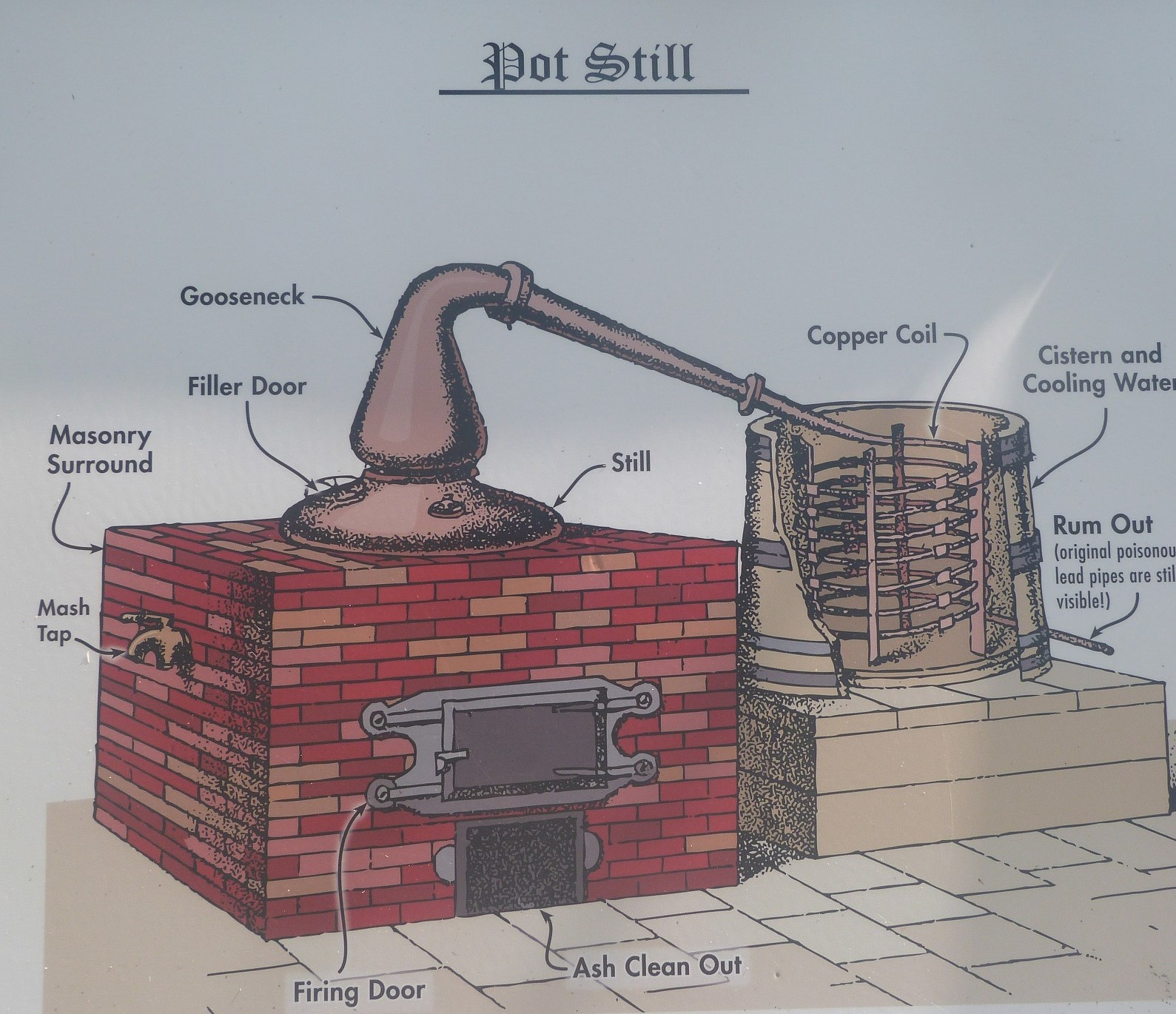
I reckon my mate John and I could make one of these...

We also pass some small houses

We also passed Bloody River - not the Bloody Bridge of the mournes but a river where the French and English managed to wipe out all 2000 of the indigenous Arawak indians of the Island. Here is a Petroglyph of theirs. The (new) locals whiten it every year.


We move on in the taxi to Brimstone hill - a very large hill at the NorthWestern Extremity that was fortified by the English. Views are good! we pass it on the boat about Midnight the next night on the way to St Martin.
 The dutch island of Eustatia is North of St Kitts, followed by Saba, we go right a bit to head to St Martin - about 40 miles away.


We are on anchor outside the tiny marina at Port Zante - the marina staff  are helpful, let us use leave our dinghy in the marina and we discover and use the showers too.

Our ship is the small one.

We also meet Austin  - owner of Pro-dive  -  a neat dive boat and we negotiate two dives for 100 USD. We ask for a wreck dive and he takes us to "Rivertaw" a wreck that is teeming with vast quanties of fish. They have also dropped a dumper and car nearby and also dropped old quay concrete to make a reef. After the wreck he takes us to a coral reef. Here are the photos - and also a video of a turtle.


 Doros's colour corrected shot of Jacks
 Lesser spotted McCrum, I am waiting for a fish to pose... (Doros's Photo again)
And Doros's photo of a small Moray - saying "Where's me teeth"

Finally I have  three videos to upload but this is breaking the blogger tool. I will try and upload them on their own blog post.

-Alan Doyle to note the Turtle - he wanted to see one. We will keep the whale video for later

We also see Lionfish - these are a recent invader to the Caribbean and are going to be a major problem - the female produces 2 million eggs and have no predators. Divers have been told to eat the little feckers. Not easy as they have poisonous spines. Cleaning them needs industrial gloves and good scissors.